Small Garden Crop Rotation: 3 Secrets That Actually Work
Why Small Garden Rotation Feels Impossible (And How to Fix It)
I tried to rotate crops in my tiny backyard garden for three years, and every time I ended up with the same problem: I'd plan a perfect four-bed rotation on paper, then realize I had exactly one bed that got enough sun for tomatoes. Sound familiar? That's the moment most small-space gardeners give up on rotation altogether. But here's what I learned after a season of failure and a season of stubborn experiments: the traditional farm-scale rotation system was never designed for a 4×8 plot. You don't need to follow those rules—you need to break them smarter. The three secrets I'm about to share work because they're built for the constraints you actually face: limited beds, overlapping seasons, and a patch of earth that measures in feet, not acres.
Let's start with the mindset shift that made everything click for me. Instead of thinking about moving crops from one bed to another in a rigid annual cycle, I started thinking about moving plant families through time and space simultaneously. That single mental flip opened up possibilities I'd never considered. By the end of this article, you'll have a concrete plan that fits your actual garden, not some idealized version from a textbook.
Secret #1: Work in Zones, Not Rows (The Grid Method)
The first secret is embarrassingly simple once you see it: stop trying to rotate individual rows. In a small garden, rows are too narrow to matter. Instead, divide your space into fixed planting zones—I use four 4×4-foot squares—and treat each zone as a single block that always holds one plant family for the season. I call this the Grid Method, and it changed everything for me.
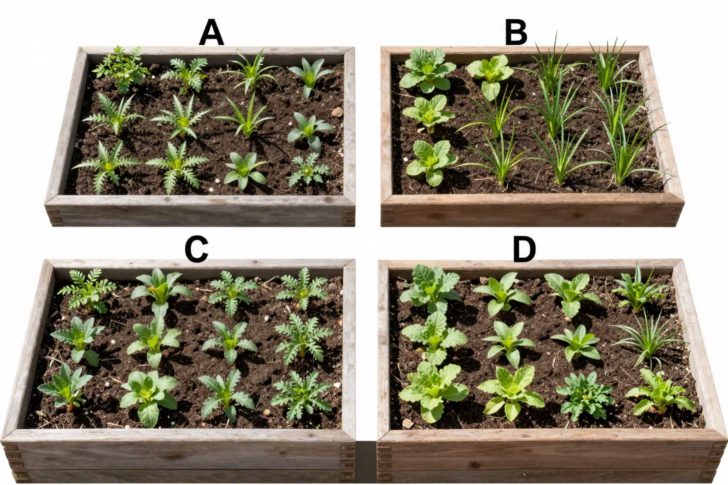
Here's how I set it up in my own 8×8-foot patch. I built four permanent raised beds, each exactly 4×4 feet. Zone 1 gets nightshades (tomatoes, peppers, eggplants). Zone 2 gets brassicas (cabbage, kale, broccoli). Zone 3 gets legumes (peas, beans). Zone 4 gets roots and alliums (carrots, onions, garlic). Each year, I shift the families one zone clockwise. That's the entire system—no measuring, no rearranging rows. In year two, Zone 1 becomes brassicas, Zone 2 becomes legumes, and so on. After four years, every family has visited every zone once.
The grid method works because it eliminates the mental overhead. You never have to decide where to put something—you just know which zone it belongs to this year. And because each zone is the same size, the math stays balanced. I tried a more complex seven-year rotation once, and my brain melted by June. This is simple enough that I actually stick to it.
One trade-off worth noting: If you grow a lot of one family—say, you're a tomato fanatic with eight plants—the grid can feel restrictive. My fix: dedicate one zone to nightshades, then use containers for a few extra tomatoes outside the rotation. That way you get both abundance and soil health.
Secret #2: Stack Families by Time, Not Just Space (Temporal Rotation)
The second secret is where things get clever. Even with four zones, you might feel like you're wasting space if a bed sits empty after an early harvest. That's when I discovered temporal rotation—stacking different plant families in the same zone within a single growing season. It's the difference between a static rotation and a dynamic one.
Here's a real example from my garden last year. In Zone 2 (which was brassicas that season), I planted kale seedlings in early April. By late June, I had harvested the outer leaves and the plants were bolting. Instead of leaving the bed fallow until I rotated brassicas again the next year, I pulled the kale, amended the soil with a thin layer of compost, and immediately planted bush beans (a legume) in the same zone. The beans fixed nitrogen for the next year's nightshades, and I got a second harvest from that bed. That's temporal rotation in action: the same physical space, two different families, one season.
You can push this further with intercropping. In my Zone 3 (legumes this year), I sowed radish seeds between the pea trellises. Radishes are brassicas (family Brassicaceae), which means I was technically rotating within the same zone—the peas used deep roots, the radishes stayed shallow, and they matured in 25 days before the peas needed the room. No disease crossover, no soil depletion, just efficient stacking.
The key rule I follow: never plant the same family twice in the same zone within a single year, but feel free to plant any other family in that zone as soon as the first crop is done. This turns your four zones into effectively eight or even twelve mini-seasons. For a small garden, this is pure gold.
Secret #3: The Container-and-Raised-Bed Swap (Mini-Rotation on Wheels)
The third secret came to me out of desperation. I had a patio that got six hours of sun, but my raised beds were in a shadier spot. I couldn't move the beds, but I could move the plants. That's when I started using containers as a rotation tool.
Here's the setup: I keep four large 20-gallon fabric pots on a wheeled platform. In spring, I plant tomatoes in two pots and peppers in two pots. They stay on the patio all summer. Meanwhile, my raised beds hold brassicas and legumes. In fall, after the tomatoes are done, I move the pots to a corner of the yard that gets less sun and plant garlic in them for overwintering. The raised beds get a cover crop of winter rye. Come spring, I swap again—the pots go back to the patio for nightshades, but this time I rotate which pot gets tomatoes versus peppers. That's a mini-rotation within the container system itself.
For even smaller spaces—think a balcony with just a few pots—you can do a full plant-family swap by physically moving containers. Label each pot with a family (e.g., "nightshade pot," "brassica pot"), and each year move them to a different spot. If you have three pots, cycle them through three locations. The soil in each pot gets a three-year break from the same family. This works because containers are inherently modular. I've seen gardeners use this method on a 6-foot balcony and get healthy yields for five straight years.
A caution from experience: container soil depletes faster than in-ground beds. After two years in the same pot, I noticed my tomatoes looked spindly. I now replace about a third of the potting mix each spring and add a slow-release organic fertilizer. That keeps the rotation effective without the soil going dead.
Putting It All Together: A Simplified 4-Bed Rotation Plan for Small Spaces
Let me give you the exact plan I use now. It combines all three secrets into one system that fits a 4×8-foot garden (two 4×4 beds) plus a few containers. You can scale it up or down.
Year 1:
- Bed 1 (Zone A): Nightshades (tomatoes, peppers).
- Bed 2 (Zone B): Brassicas (kale, broccoli).
- Containers: Legumes (peas in two pots) and roots (carrots in one pot).
- Temporal trick: After brassicas are harvested in July, plant bush beans in Bed 2.
Year 2:
- Bed 1 (Zone A becomes B): Brassicas.
- Bed 2 (Zone B becomes C): Legumes (bush beans).
- Containers: Nightshades (tomatoes, peppers).
- Temporal trick: After brassicas are done, plant a quick crop of radishes in Bed 1.
Year 3:
- Bed 1 (Zone A becomes C): Legumes.
- Bed 2 (Zone B becomes D): Roots and alliums (carrots, onions).
- Containers: Brassicas (kale, broccoli).
- Temporal trick: After legumes are harvested, plant a fall crop of spinach (brassica family) in Bed 1.
Year 4:
- Bed 1 (Zone A becomes D): Roots and alliums.
- Bed 2 (Zone B becomes A): Nightshades.
- Containers: Legumes.
- Temporal trick: After alliums are done, plant a late-summer crop of bush beans in Bed 1.
Notice how the containers act as a third and fourth zone, giving you a full four-year rotation even with only two beds. If you have only one raised bed, drop the beds to a two-year rotation and rely heavily on containers for the other families. If you have zero beds, just use four large containers and rotate them through four spots on your patio or balcony.
The single most important takeaway I can offer: rotation in a small garden isn't about perfection—it's about progress. Even a simple two-year shift between heavy feeders (nightshades, brassicas) and light feeders (legumes, roots) will improve your soil and reduce disease. Start with the grid method, add temporal stacking as you get comfortable, and use containers as your wild card. Your garden will thank you, and so will your harvest.
If you found this helpful, bookmark it for next season—you'll want the schedule handy when you're planning spring planting. And if you're ready to go deeper, check out our guide on how to improve soil in a small vegetable garden for the next step.